.png)
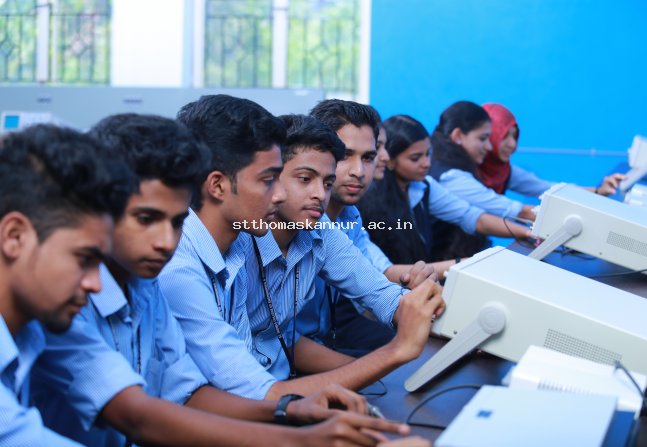
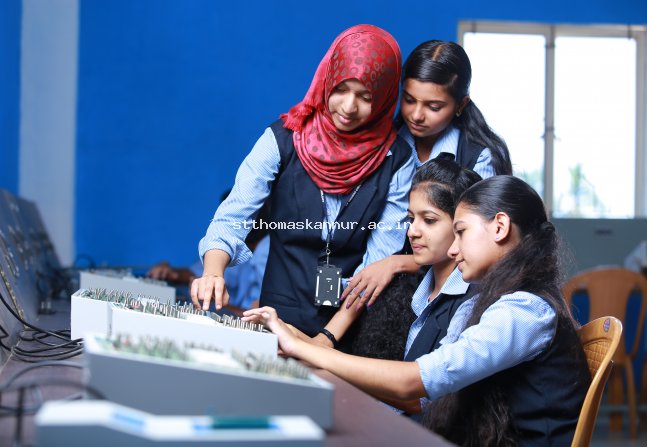
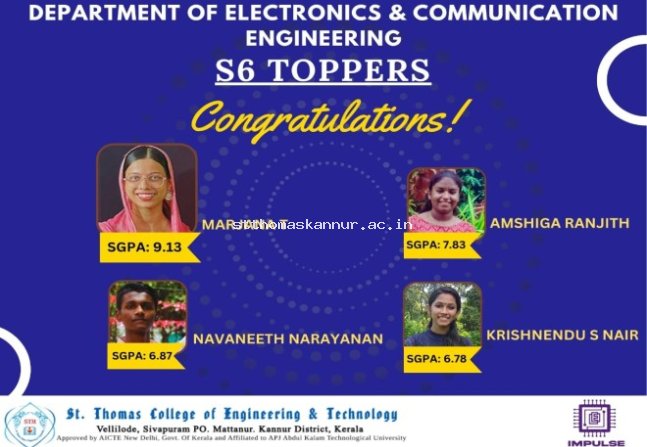
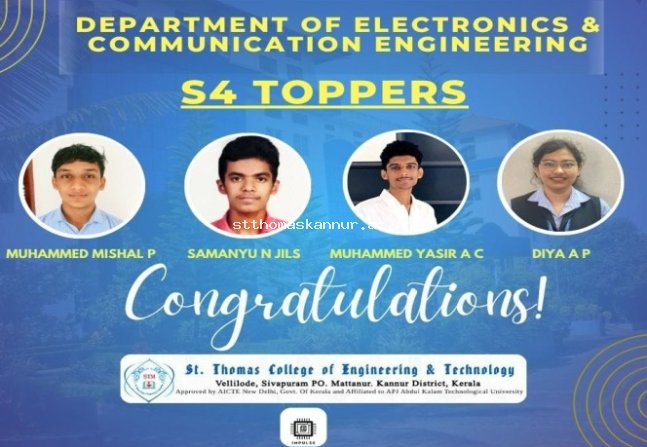
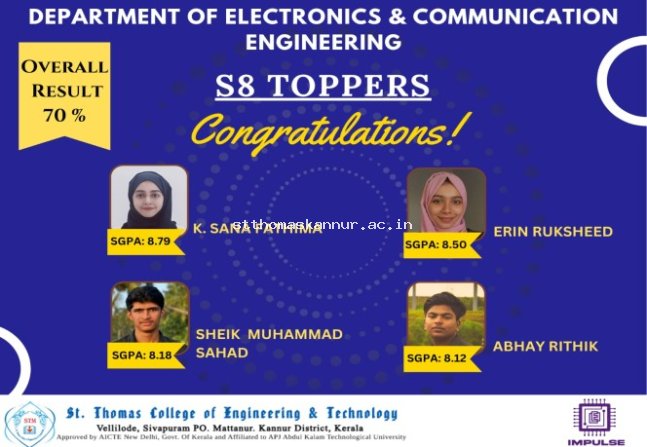
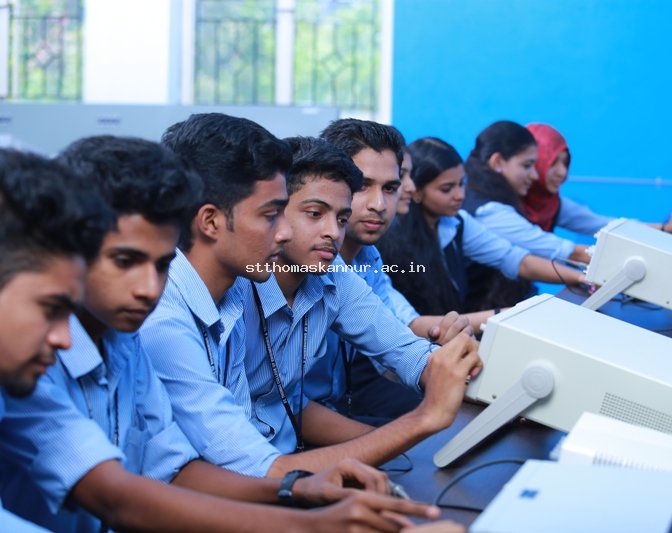
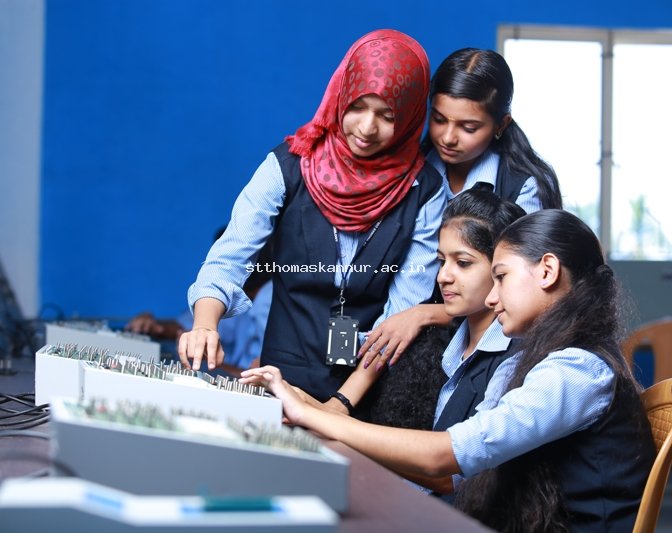
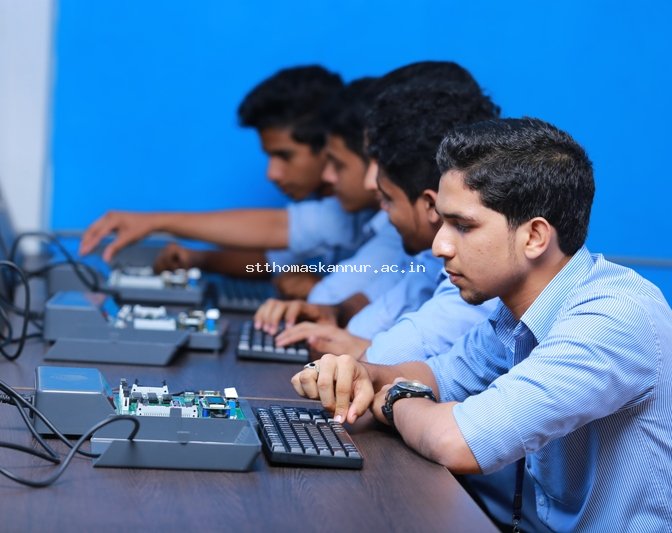
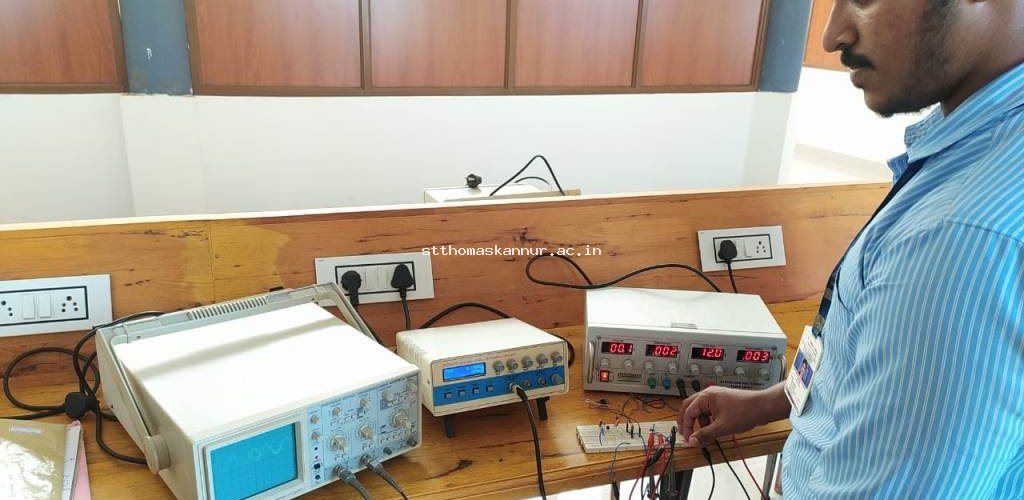
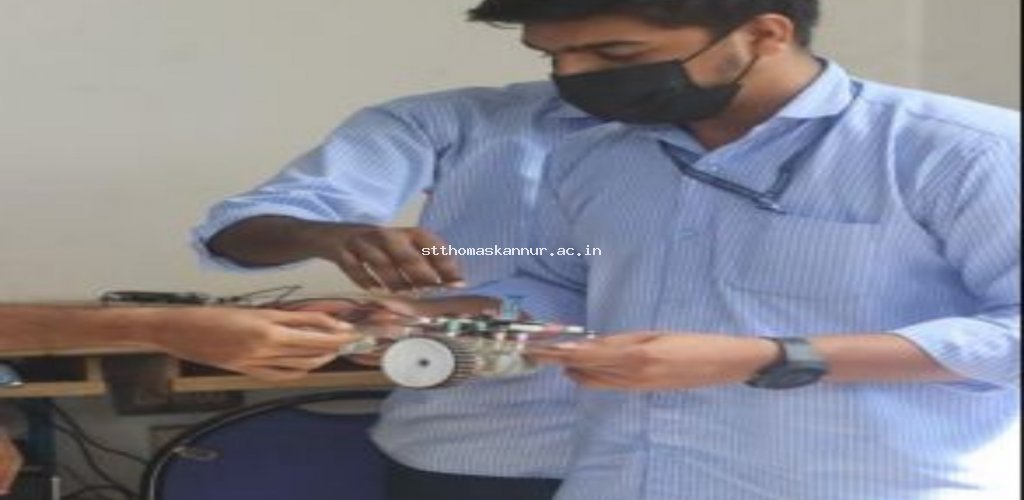
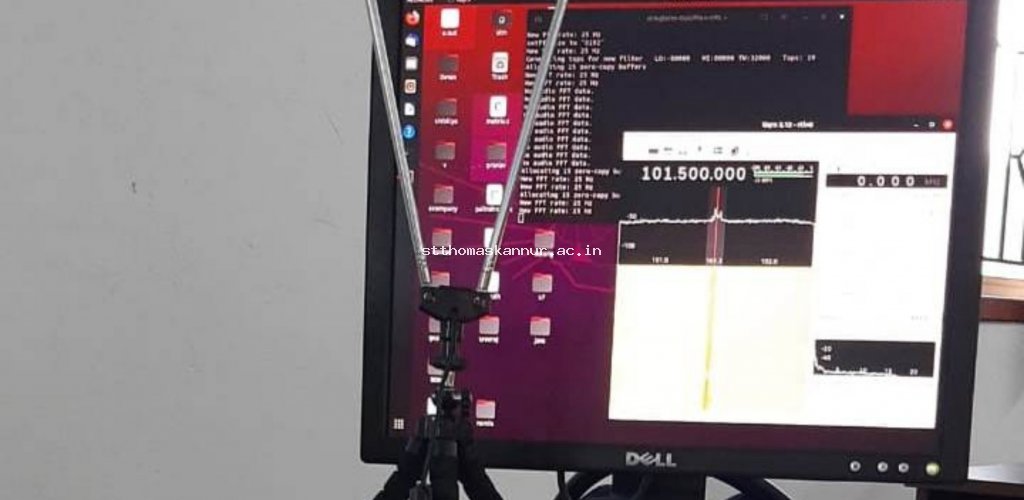
The field of electronics and communication engineering involves developing and testing electronic circuits and communication devices such as transmitters, receivers, and integrated circuits. In this domain, engineers often need to use the principles of digital and analogue transmission. As part of this field of engineering, engineers also work with microprocessors, solid-state devices, satellite communication tools, circuits, and electronic devices. The department is having a good infrastructure and resource to cater to the needs of the student to achieve our vision. The outcome based education (OBE) system is followed at the department
Vision
To produce professionally competent, ethically sound and socially responsible Electronics and Communication Engineers.
Mission
M1: Provide excellent infrastructure and lab facilities for quality education.
M2: Promote industry-academic interactions to keep up with technological advancements.
M3: Develop interpersonal skills and social responsibility among students through project-based and team-based learning.
PROGRAM EDUCATIONAL OBJECTIVES (PEO)
Graduates of B. Tech ECE program after graduation will:
PEO1: Exemplify technical competence in designing, analyzing, testing and fabricating
electronic circuits.PEO2: Acquire leadership qualities, rapport, communication skills in the organization and adapt to changing professional and societal needs.
PEO3: Work effectively as individuals and as team members in multidisciplinary projects
PROGRAM SPECIFIC OUTCOMES (PSO)
PSO1: Define, design, implement, model, and test electronic circuits and systems that perform signal processing functions.
PSO2: Segregate and select appropriate technologies for implementation of a modern communication system.
Program Outcomes (POs)
Engineering Graduates will be able to:
PO1 Engineering Knowledge: Apply knowledge of mathematics, natural science, computing, engineering fundamentals and an engineering specialization as specified in WK1 to WK4 respectively to develop to the solution of complex engineering problems.
PO2 Problem Analysis: Identify, formulate, review research literature and analyze complex engineering problems reaching substantiated conclusions with consideration for sustainable development. (WK1 to WK4)
PO3 Design/Development of Solutions: Design creative solutions for complex engineering problems and design/develop systems/components/processes to meet identified needs with consideration for the public health and safety, whole-life cost, net zero carbon, culture, society and environment as required. (WK5)
PO4 Conduct Investigations of Complex Problems: Conduct investigations of complex engineering problems using research-based knowledge including design of experiments, modelling, analysis & interpretation of data to provide valid conclusions. (WK8).
PO5 Engineering Tool Usage: Create, select and apply appropriate techniques, resources and modern engineering & IT tools, including prediction and modelling recognizing their limitations to solve complex engineering problems. (WK2 and WK6).
PO6 The Engineer and The World: Analyze and evaluate societal and environmental aspects while solving complex engineering problems for its impact on sustainability with reference to economy, health, safety, legal framework, culture and environment. (WK1, WK5, and WK7).
PO7 Ethics: Apply ethical principles and commit to professional ethics, human values, diversity and inclusion; adhere to national & international laws. (WK9).
PO 8 Individual and Collaborative Team work: Function effectively as an individual, and as a member or leader in diverse/multi-disciplinary teams.
PO9 Communication: Communicate effectively and inclusively within the engineering community and society at large, such as being able to comprehend and write effective reports and design documentation, make effective presentations considering cultural, language, and learning differences.
PO10 Project Management and Finance: Apply knowledge and understanding of engineering management principles and economic decision-making and apply these to one’s own work, as a member and leader in a team, and to manage projects and in multidisciplinary environments.
PO11 Life-Long Learning: Recognize the need for, and have the preparation and ability for i) independent and life-long learning ii) adaptability to new and emerging technologies and iii) critical thinking in the broadest context of technological change. (WK8)
DEPARTMENT ADVISORY BOARD
Dr. Peethambaran K M Chairman
Principal, St. Thomas College of Engineering and Technology
Sivapuram, Mattanur, KannurEr. Rijo Thomas Jose Management Representative
CEO, St. Thomas College of Engineering and Technology
Sivapuram, Mattanur, KannurMr.Nithin C Convener
Assistant Professor and HOD,
St. Thomas College of Engineering and Technology
Sivapuram, Mattanur, KannurMr. Manu Thomas Co-Convener
Department of ECE
St. Thomas College of Engineering and Technology
Sivapuram, Mattanur, KannurMr.Vibin Kumar V B Industry Member
Junior Engineer, Core Network
Transmission, BSNL,AluvaMr.Kathiru Santhikumar Industrial Member
Chief technical officer, ThinkFoTech
Innovations, Kinfra park, KannurDr.Rajeesh J Academic Member
Professor, Department of ECE,
College of Engineering, KidangoorMr.Arun Varghese Academic Member
Associate professor
Department of ECE
GEC, WayanadMs.Primiya Prabhakaran Alumni Member
Junior Software Test Engineer,
SLK software services pvt.ltd. Bangalore
PROGRAM ASSESSMENT COMMITTEE
Mr. Nithin C (HOD ECE Dept) - Chairman
Mr. Manu Thomas (Assistant professor ECE Dept) - Program Coordinator
Ms. Sreetha Sreedhar K. (Assistant professor ECE Dept) - Stream Coordinator
Ms. Athira V. (Assistant professor ECE Dept) - DQAC Coordinator
Ms. Arya C. (Assistant professor ECE Dept) - Faculty advisor
Mr. Samanyu N Jils (Student (2023-27 batch)) - Student Representative
Special Interest Groups
The department has following special interest groups
- Embedded Systems
Promoters: Asst. Prof. Manu Thomas
- Signal Processing
Promoters: Asst. Prof. Athira V
Highlights
- Highly qualified, experienced & dedicated faculty.
- Excellent infrastructure & facilities
- Excellent Placements.
- Invited Lecture Series providing the platform for distinguished speakers to interact with students.
- High-quality laboratory facilities with advanced Microwave and Digital Labs.
- Fully automated library and subscription to quality online/ print journals.
- Regular Industrial tours & visits.
- Value-Added programmes & personality development programmes on offer.